Welcome to the Documentation of WaveBreaking!
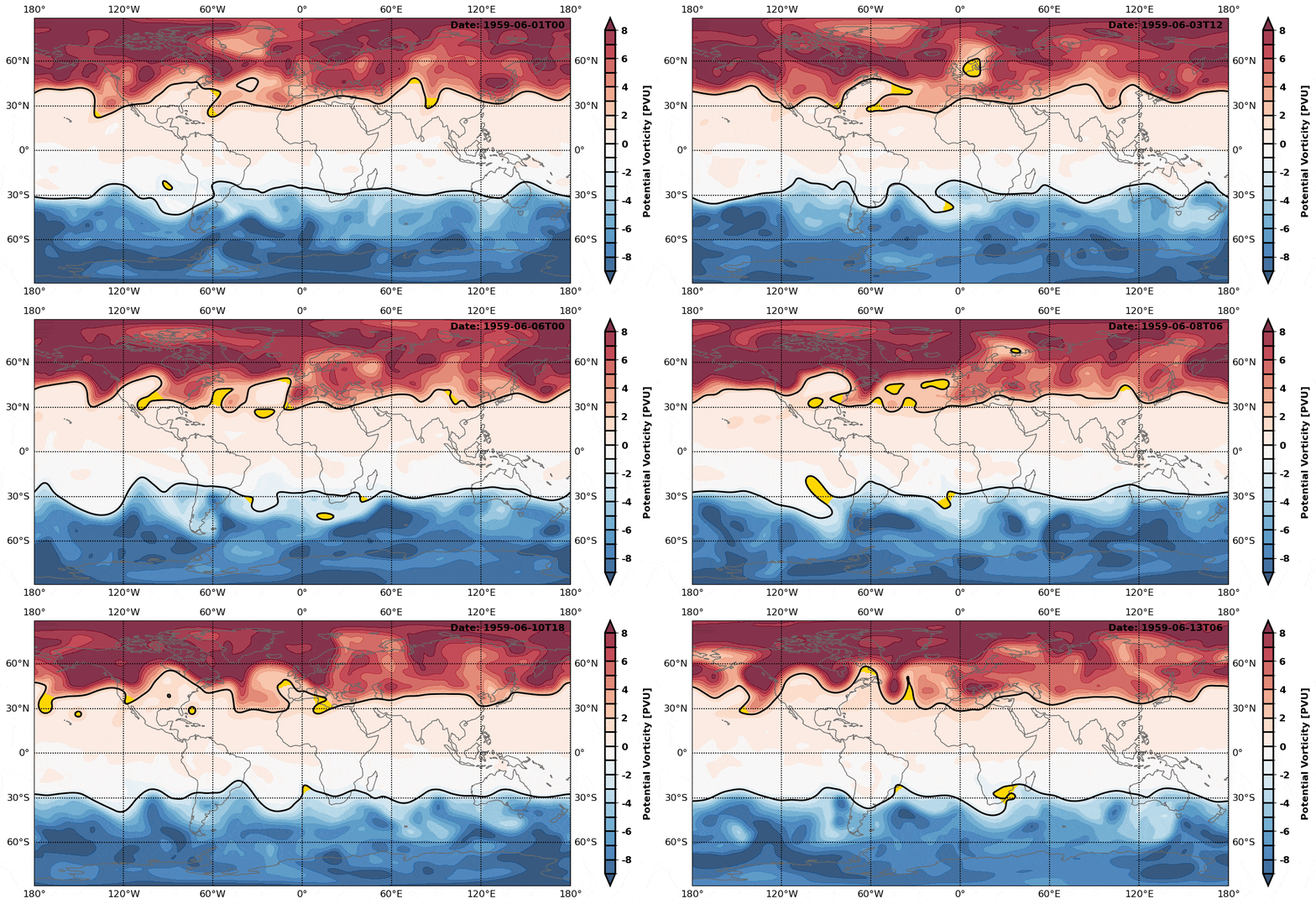
WaveBreaking is a Python package that provides detection, classification and tracking of Rossby Wave Breaking (RWB) in weather and climate data. The detection of RWB is based on analyzing the dynamical tropopause represented by a closed contour line encircling the pole as for example the 2 Potential Vorticity Units (PVU) contour line in Potential Vorticity (PV) fields. By applying three different breaking indices, regions of RWB are identified and different characteristics of the events such as area and intensity are calculated. The event tracking provides information about the temporal evolution of the RWB events. Finally, the implemented plotting methods allow for a first visualization. This tool was developed during my master studies at the University of Bern.
The detection of RWB is based on applying a RWB index to the dynamical tropopause. The WaveBreaking package provides three different RWB indices:
Streamer Index: The streamer index is based on work by Wernli and Sprenger (2007) (and Sprenger et al. 2017). Streamers are elongated structures present on the contour line that represents the dynamical tropopause. They can be described by a pair of contour points that are close together considering their geographical distance but far apart considering their distance connecting the points on the contour. Further description can be found in my master thesis.
Overturning Index: The overturning index is based on work by Barnes and Hartmann (2012). This index identifies overturning structures of the contour line. An overturning of the contour line is present if the contour intersects at least three times with the same longitude. Further description can be found in my master thesis.
Cutoff Index: The Cutoff Index provides information about the decaying of a wave breaking event. From a Potential Vorticity perspective, a wave breaking event is formed by an elongation of the 2 PVU contour line. These so-called streamers can elongate further until they separate from the main stratospheric or tropospheric body. The separated structure is referred to as a cutoff (Wernli and Sprenger (2007).
The tool is designed to analyze gridded data provided as an xarray.DataArray. Output is provided either in a geopandas.GeoDataFrame or in an xarray.DataArray.
Parts of the data setup functions and of the tracking function are based on the ConTrack - Contour Tracking tool developed by Daniel Steinfeld.
Important information:
Free software: MIT license
Further documentation about the implemented methods can be found in my master thesis.
Referencing:
Please cite WaveBreaking in your publication: Kaderli, S., 2023. WaveBreaking - Detection, Classification and Tracking of Rossby Wave Breaking. https://doi.org/10.5281/zenodo.14214463
If you are using the Streamer Index, please cite Wernli and Sprenger (2007) (and Sprenger et al. 2017).
If you are using the Overturning INdex, please cite Barnes and Hartmann (2012).
Contents: